

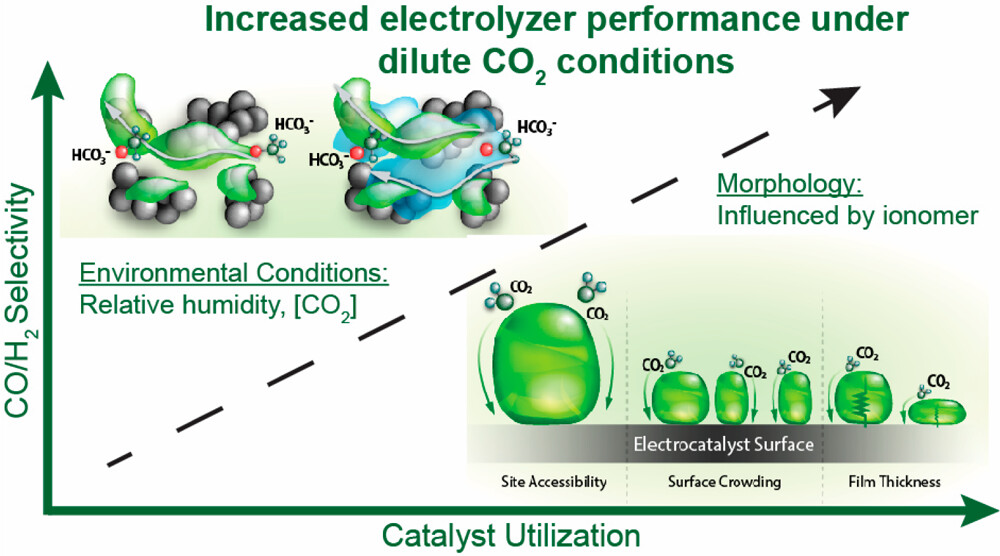
While low-temperature electrochemical CO2 reduction has demonstrated high CO selectivity with pure CO2 in zero-gap anion exchange membrane CO2 electrolyzer, there is a significant knowledge gap regarding its performance in environments with CO2 concentrations below 30%. This is a critical aspect for integrating these devices into practical applications where CO2 is captured from point sources. To bridge this gap, Henckel … Read More
Importance of Substrate Pore Size and Wetting Behavior in Gas Diffusion Electrodes for CO2 Reduction
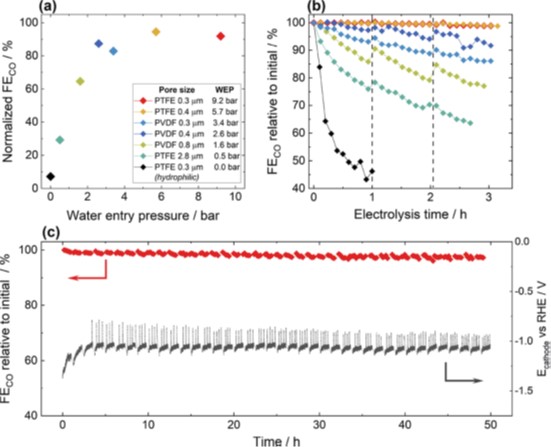
Developing catalysts with high activity, high selectivity, and long-term stability is an important aspect in electrochemical CO2 reduction (CO2RR). Currently, carbon-based gas diffusion electrodes (GDEs) are the extensively used and investigated electrodes in CO2RR. GDEs reduce mass transport limitations associated with the low solubility of CO2 in aqueous electrodes by providing gaseous CO2 to and near the catalyst. However, carbon-based … Read More
Through-Plane Conductivity of Anion Exchange Membranes
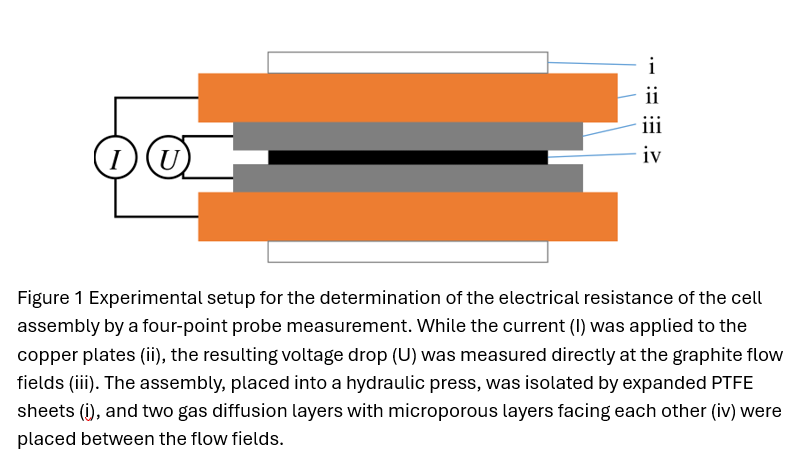
Anion exchange membrane (AEM) is considered as an alternative for proton exchange membrane (PEM) due to their potential utilizing platinum group metal (PGM) free catalysts in both fuel cells and electrolyzers. However, the true hydroxide conductivity of alkaline ionomers/membranes are not yet well-characterized partially due to their sensitivity to carbon dioxide (CO2) in air. Schwämmlein et al. (https://iopscience.iop.org/article/10.1149/1945-7111/ab8cdf/pdf) reported a … Read More
Insights into membrane-separated organic electrosynthesis: the case of adiponitrile electrochemical production
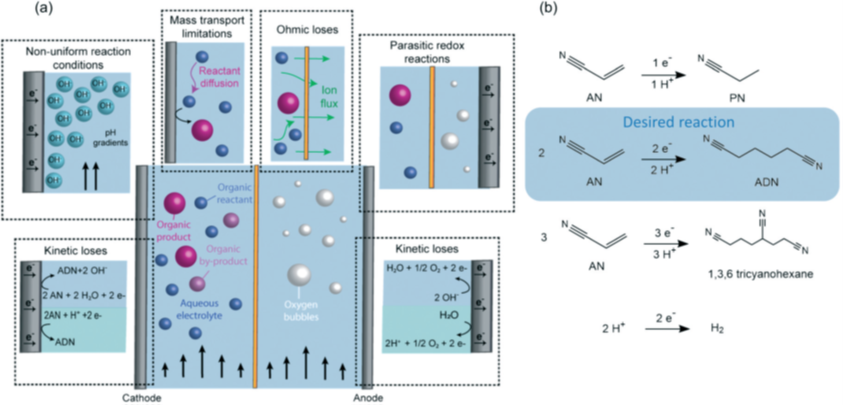
Membrane-separated electrochemical reactors have the potential to improve chemical manufacturing practices as they can lead to significant enhancements in energy conversion efficiency and reductions in manufacturing costs. The ion exchange membranes used in such reactors can (i) help prevent reactions of products and reactants in opposite chambers, (ii) allow the independent optimization of cathodic/anodic reaction conditions, and (iii) reduce the … Read More
Energy- and carbon-efficient CO2/CO electrolysis to multicarbon products
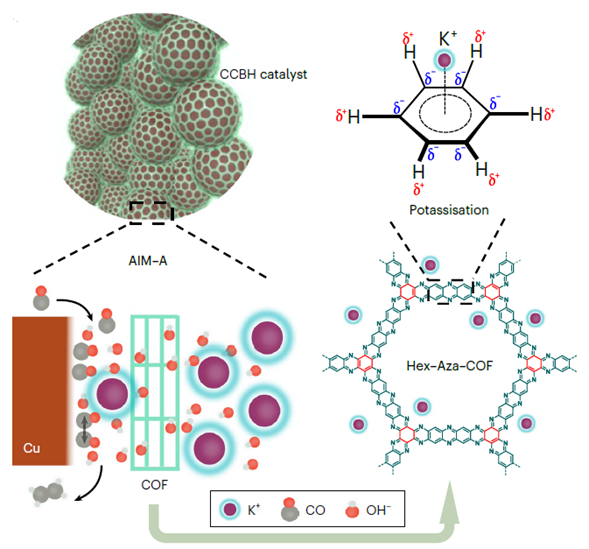
Carbon dioxide/monoxide (CO2/CO) electrolysis provides a pathway to convert CO2 into multicarbon products. However, the energy and carbon efficiencies are low due to the uncontrolled gas/ion distributions in the local reaction environment. In the best current zero-gap CO2RR/CORR electrolyzers, cations (K+) crossover from the anode to the cathode, accumulate on the catalyst surface, block the active sites, limit CO adsorption … Read More
The Conventional Gas Diffusion Electrode May Not Be Resistant to Flooding during CO2/CO Reduction

The electrochemical CO2 or CO reduction to chemicals and fuels using renewable energy is a promising way to reduce anthropogenic carbon emissions. The gas diffusion electrode (GDE) design enables low-carbon manufacturing of target products at a current density (e.g., 500 mA cm−2) relevant to industrial requirements. However, the long-term stability of the GDE is restricted by poor water management and … Read More
Ultra-low IrO2 catalysts for alkaline water/seawater electrolysis
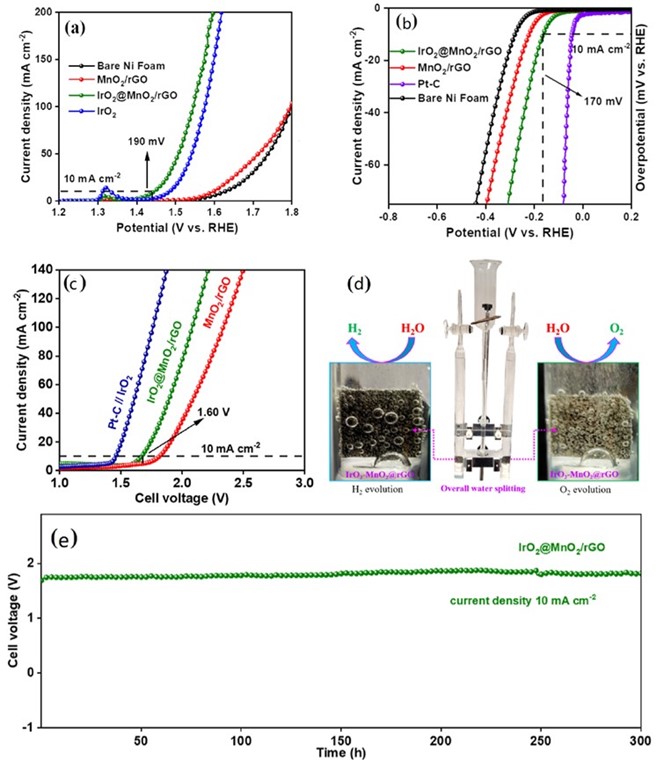
(a) OER polarization curves of IrO2@MnO2/rGO, MnO2/rGO, IrO2, and bare nickel foam (b) HER polarization curves of IrO2@MnO2/rGO, MnO2/rGO, Pt−C, and bare nickel foamin 1.0 M KOH at 1 mV s−1 (iR corrected) (c) Overall water-splitting device performance and (d) a picture of the device, (e) Chronopotentiometry curve for IrO2@MnO2/rGO||IrO2@MnO2/rGO at 10 mA cm−2 for 300 h. Hydrogen is a … Read More
Continuous electroreduction of CO2 towards formate in gas-phase operation at high current densities with an anion exchange membrane
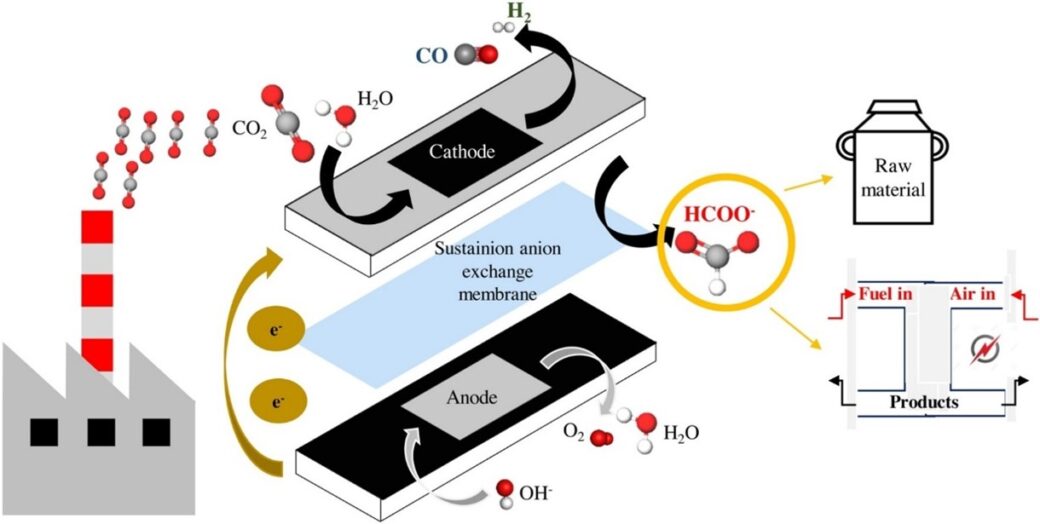
Electrochemical CO2 reduction to formic acid or formate is considered as a promising approach to convert CO2 to value-added product and a strategy of mitigating climate change. Recently, Diaz-Sainz and coworkers developed a novel electrolyzer cell configuration which allows the electrolyzer to run at a high current density with promising Faradaic Efficiency, energy consumptions, and product rates. Their work was … Read More
Asymmetrical electrohydrogenation of CO2 to ethanol with copper-gold heterojunctions
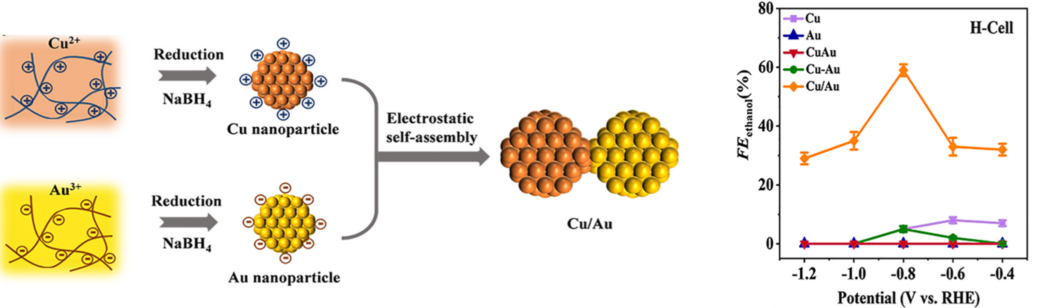
Electrochemical CO2 reduction is a promising strategy to store renewable electrical energy in the chemical bonds of carbon fuels. Currently, high performance has been reported for C1 products, like CO and formate. However, C2 products such as ethanol are produced competitively with ethylene, due to shared reaction pathways. Enhanced ethylene production has been achieved by implementing Cu-based catalysts via materials … Read More
Anodic Gas Separation in CO2 Electrolysis System
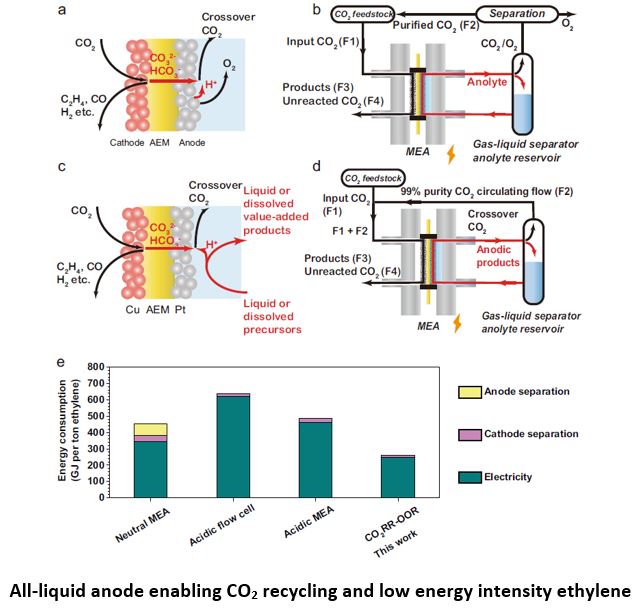
At present, electrochemical reduction of CO2 is favored at cathode under highly alkaline conditions while O2 is produced via oxygen evolution reaction (OER) at anode. Unfortunately, carbonate is formed under these conditions, consuming both OH– and CO2 thus lowering the local pH and carbon efficiency. Anion exchange membrane, separating cathode and anode of the electrolyzer, enables a high local pH … Read More