

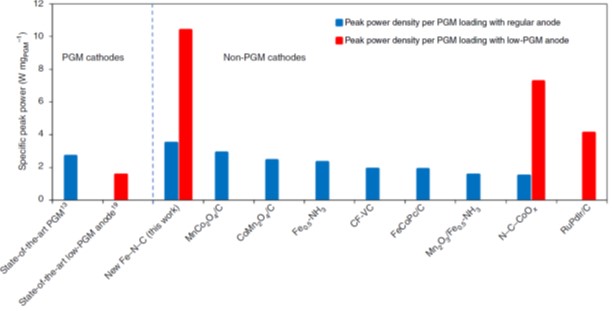
Low-temperature polymer electrolyte fuel cells need to overcome considerable cost barriers to be considered as the ultimate power source for transportation systems and portable devices. Although the estimated cost of a proton-exchange membrane fuel cell (PEMFC) has been markedly reduced, it has plateaued in recent years, which has led to the consideration of anion-exchange membrane fuel cells (AEMFCs). Compared to … Read More
Size-Dependent Silver Nanoparticle Electrocatalysts for CO2 Reduction to CO
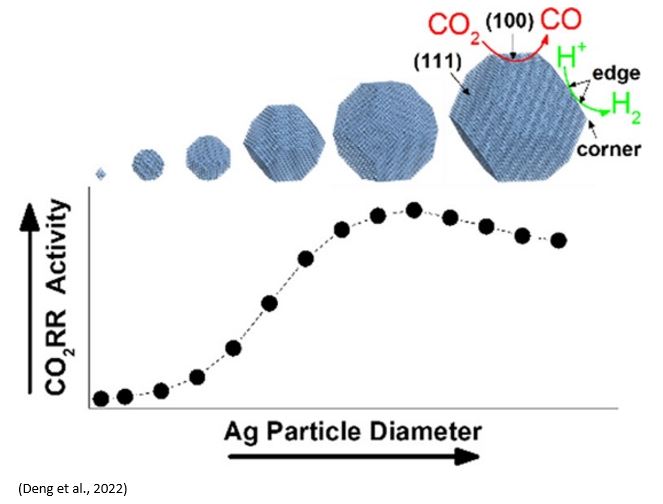
Silver (Ag) is the state-of-the-art electrocatalyst for selective carbon monoxide (CO) production from waste carbon emissions. Deng et al. (https://doi.org/10.1021/acscatal.2c00960) recently investigated the size-dependent transition between CO2 reduction reaction and H2 evolution reaction on silver nanoparticle electrocatalysts. Ag nanoparticles were grown under ultrahigh vacuum (UHV) via metal evaporation onto highly oriented pyrolytic graphite (HOPG) substrate. The results showed that CO2RR … Read More
Investigation and mitigation of degradation mechanisms in Cu2O photoelectrodes for CO2 reduction to ethylene
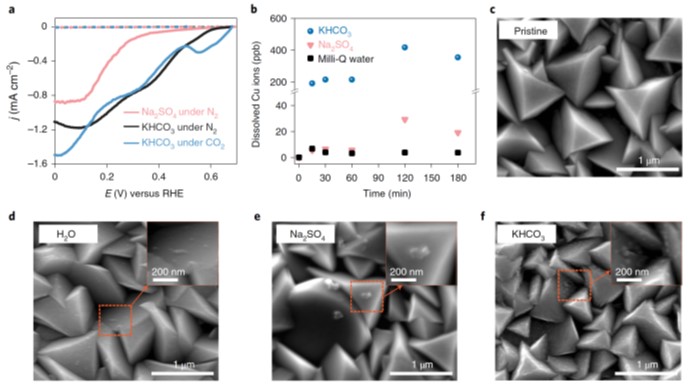
There is a growing interest in the conversion and storage of renewable solar energy via reduction of carbon dioxide into clean fuels, as an alternative to fossil fuels. Photoelectrochemical (PEC) devices, which use semiconducting photoelectrodes to absorb solar energy and drive uphill chemical reactions, constitute a promising approach to achieve this goal. However, both photoanodes and photocathodes usually suffer from … Read More
Stable photoelectrodes for CO2 reduction to ethylene
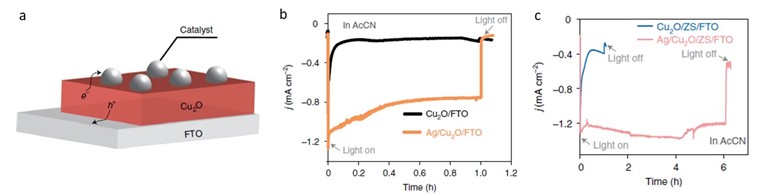
Metal oxides experienced chemical transformation under operating conditions that limits their applications for photosynthesis. Liu et al. (doi.org/10.1038/s41560-021-00927-1) recently found that under illumination the Cu2O concurrently undergoes reduction by photoelectrons and oxidation by holes in the material. A protection scheme was proposed where an Ag catalyst was used to accelerate electron transfer and a Z-scheme heterojunction to extract holes. The … Read More
Regulating the Electron Localization of Metallic Bismuth for Boosting CO2 Electroreduction
Electrochemical CO2 reduction reaction (CO2RR) is considered an attractive route to energy and environmental sustainability. Based on techno-economic analysis, formate/formic acid is suggested to be one of the most economically profitable products at industrial scale through CO2RR. However, high faradic efficiency usually is limited to a very narrow potential window and cannot be maintained at high current density which is … Read More
Boosting CO2 Electroreduction Using Advanced Electrocatalysts and Cell Configurations
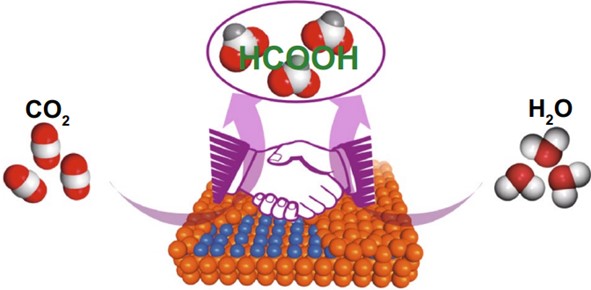
Electrochemical reduction of CO2 to formate is economically attractive but improving the reaction selectivity and activity remains challenging. Fu et al. reported that B dopped Bi electrocatalyst converted CO2 into formate with high activity and selectivity in a wide potential window. In their paper (doi.org/10.1007/s40820-021-00772-7), boron (B) atoms were introduced to modify the local electronic structure of bismuth catalyst with … Read More
Optimizing the Ink Formulation for Preparation of Cu-Based Gas Diffusion Electrodes Yielding Ethylene in Electroreduction of CO2
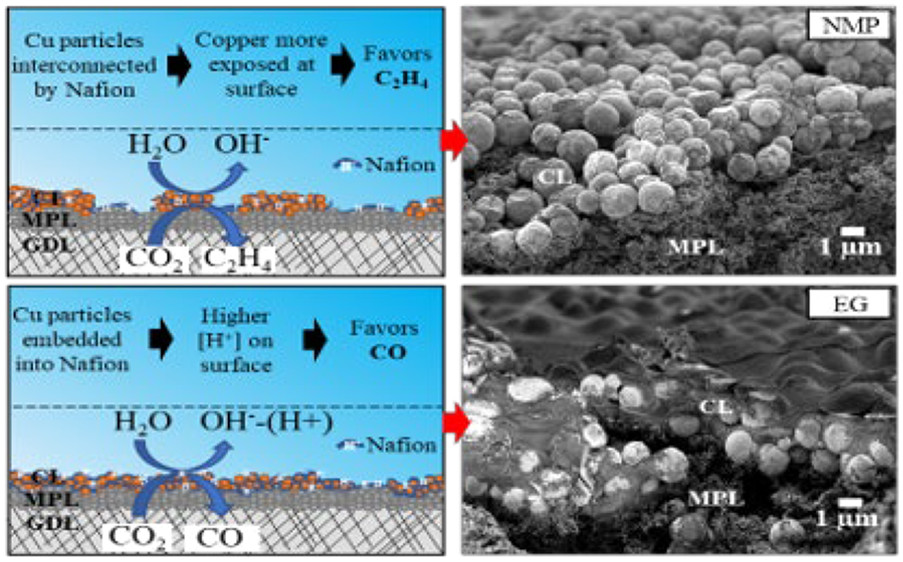
Cu-based gas diffusion electrodes (GDEs) show excellent performance in the electrochemical reduction of CO2 to ethylene. For the preparation of a GDE, a conductive ionomer is typically mixed with the electrocatalyst in a solvent to prepare an ink, followed by spraying of the mixture onto a gas diffusion layer (GDL) of a carbon cloth or carbon paper. This procedure should … Read More
Defective Carbon‑based Electrocatalysts for Carbon Dioxide Reduction
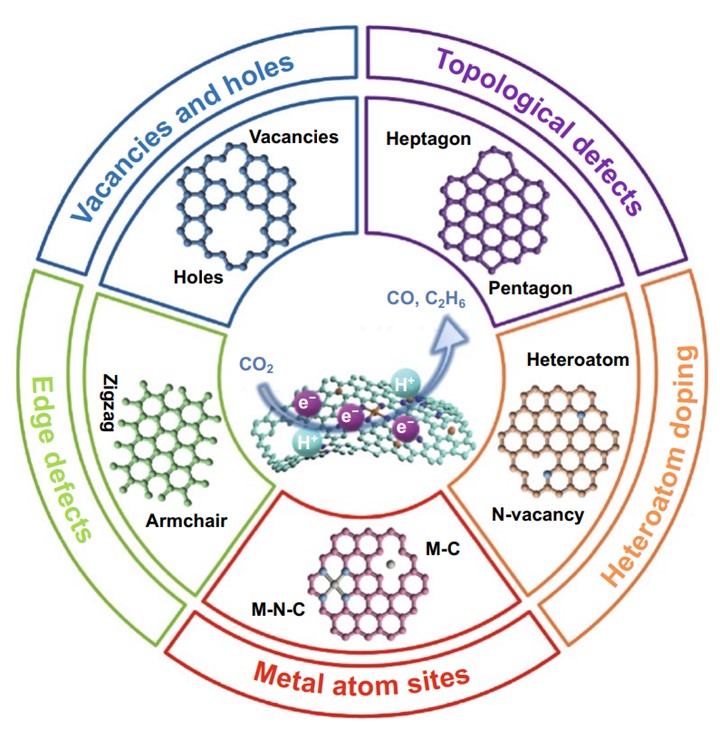
Electrocatalytic carbon dioxide (CO2) reduction (ECR) holds the potential to close the carbon cycle and store renewable energy. However, there are still some problems such as low activity and selectivity, and poor stability. One of the most promising strategies to improve ECR activity is to develop electrocatalysts with low cost, high activity, and long-term stability. Recently, defective carbon-based nanomaterials have … Read More
Ultrastable Cu Catalyst for CO2 Electroredction to Multicarbon Liquid Fuels by Tuning C-C Coupling with CuTi Subsurface
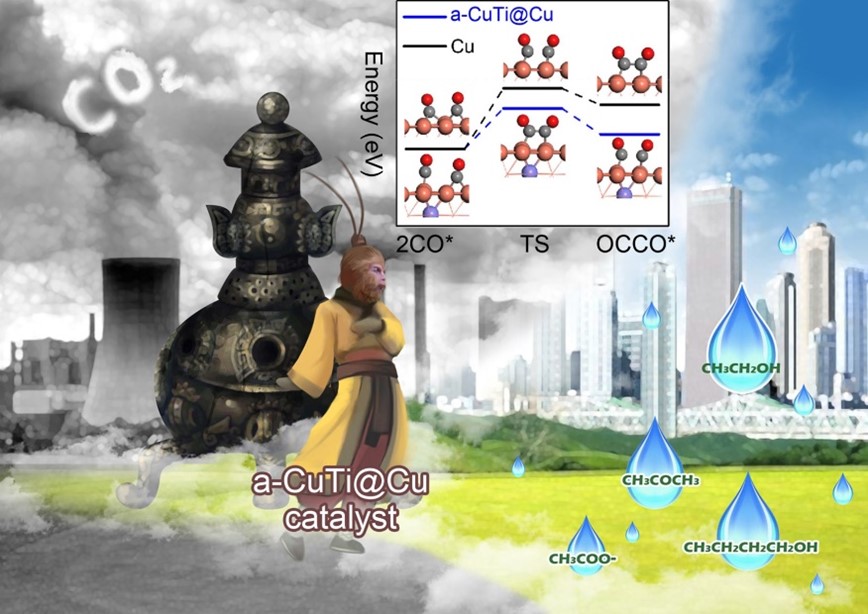
The Electrochemical reduction of CO2 to liquid fuels is highly desirable due to the high energy density and security in storage and transportation of the liquid fuels. Normally, the design of highly active and efficient catalytic materials is the key to the CO2 conversion to C2+ fuels. Among various electrocatalysts, copper (Cu)-based materials are considered the best catalyst candidates for … Read More
Strategies to produce high-purity and high-concentration of liquid fuels from carbon dioxide
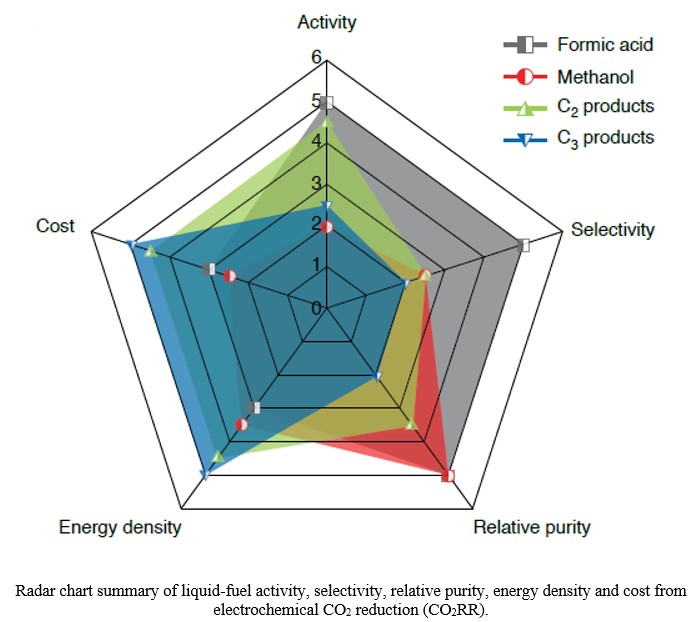
As the renewable electricity price falls continuously, liquid fuels generated from the electrochemical CO2 reduction reaction (CO2RR) are of particular interest due to their high energy densities and ease of storage and distribution. Unfortunately, they are typically formed in low concentrations and mixed with impurities due to the current limitations of traditional CO2 electrolysers as well as CO2RR catalysts. Therefore, … Read More